An Association in Transition
Disbelief, excitement and joy
35 years of the ASB in eastern and central Germany – a success story
The re-founding of the ASB in the GDR was a tremendous effort that paid off. From the first courageous steps after the fall of the Wall to today’s modern aid and welfare organisation, it was an arduous journey. 35 years ago, the ASB became the first all-German welfare association in Germany and today also makes an indispensable contribution to society in the five federal states of eastern and central Germany.
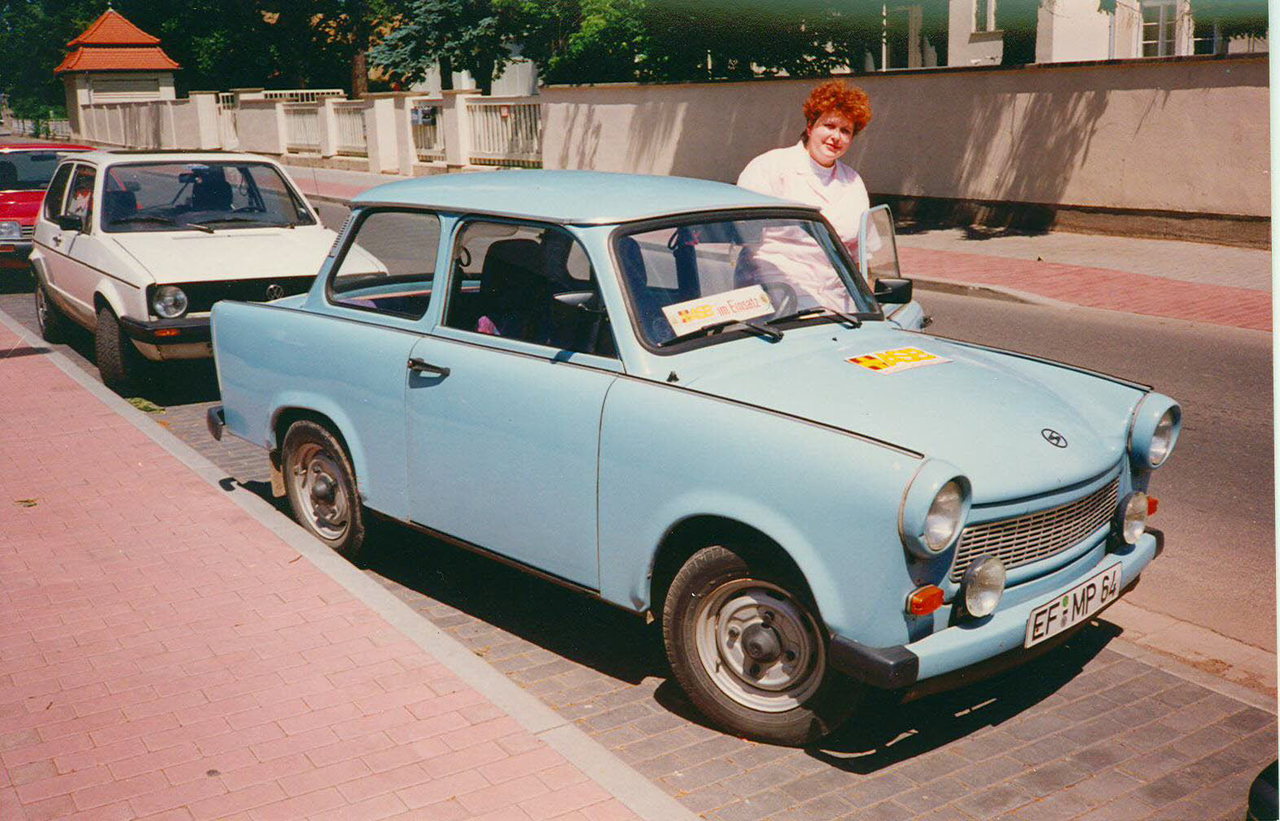
Then: Monika Prinz worked at the ASB social care station in Erfurt from 1992 to 1998: “When our outpatient care service got going back then, there weren’t many cars. We gave the ASB our Trabi and from then on I had a company car.”

And today: Sophie Halbritter, an employee of outpatient care at the ASB Regionalverband Ostthüringen/Gera, in front of her electric vehicle at the Wiesestraße location.
Disbelief, excitement, joy – these were the prevailing feelings when the then SED politician Günter Schabowski almost casually opened the Wall on the evening of 9 November 1989. Tens of thousands of people then set off for the various Berlin border crossings, full of disbelief and hope. After 28 years of separation, the barriers rose, and people from East and West cheered and celebrated together. The division of Germany was history. In the Bundestag in Bonn, Annemarie Renger, then Vice-President of the Bundestag and ASB President, announced the opening of the border during a session of the Bundestag.
The beginning of a turbulent journey through time
At the same time, this opened up the way back to eastern and central Germany for the ASB. From January 1990, the ASB was ready to rebuild an organisation that had not been allowed to exist since 1933. As early as December 1989, all ASB branches were asked by the Federal Office in Cologne to use their contacts to re-found the ASB in the GDR. The appeal was actually not even necessary, because the branches in the West had already taken the initiative.
On 27 January 1990, the first ASB local branch on East German soil was re-founded in Mecklenburg-Vorpommern. In Güstrow, 16 committed people from East and West gathered in the home of Jürgen and Sybille Wangerin. They had come together to put a non-profit aid service alongside the overstretched state structure in the region.
A unique act of solidarity between East and West
The ASB began its re-founding at breathtaking speed. Within the first half of 1990, there were ASB local branches again in all the larger cities of the GDR. This was made possible by a unique act of solidarity by all branches in West Germany – together with thousands of GDR citizens who joined forces on the ground.
On 13 October 1990, the new ASB regional chairs and their deputies were already represented at the meeting of the Federal Committee in Cologne. The agenda included the “admission of five new regional associations into the ASB”, which was approved unanimously. The then ASB Federal Chair Martin Ehmer and ASB President Annemarie Renger proudly announced that the ASB was thus the first all-German welfare organisation.
The greatest event in ASB history
What many had long thought impossible finally came true in 1990: 57 years after the ban by the National Socialists and the post-war period, there were ASB branches on East German soil again. This success story was written by women and men who did not hesitate after the fall of the Wall and threw themselves eagerly into rebuilding the ASB. Thanks for so much commitment are due to the founders and helpers, the members, the supporters and the volunteers, as well as to all paid staff at the ASB. They all contributed significantly to the success of the ASB in eastern Germany and made it a hallmark of solidarity and tolerance.
Further development since the 2000s
After the consolidation phase, the ASB in the “new” federal states developed into a modern, highly specialised social and service association with a strong volunteer foundation.
Professionalisation in social work:
In view of demographic change in the East, the ASB specialised strongly in care. Modern senior centres, assisted living facilities, outpatient care services and social care stations were established. The ASB pushed ahead with expanding its role as provider of day-care centres, after-school groups and school social work in order to meet changing societal demands.
Expansion in disaster control:
The once-in-a-century floods on the Elbe, Mulde and Saale in 2002 and 2013 were among the largest disaster control operations in the history of the East German ASB regional associations. They showed how firmly the ASB had established itself as an operational pillar of civil protection in the “new” federal states in the years after its re-founding.
Integration of the emergency medical services:
The structures of the emergency medical services were gradually modernised in line with modern, statewide quality standards. Forward-looking dispatch systems, tele-emergency physician projects and digital training became established.
Introduction of the ASB Wünschewagen:
From 2015, the volunteer project also got under way in eastern Germany, where it is now in operation with five vehicles.
Refugee aid 2015/2016:
During the migration movement, the ASB in all five new federal states took on the establishment and operation of numerous initial reception facilities, emergency shelters and integration programmes.
The 2020s:
The East German ASB regional associations formed a backbone during the coronavirus crisis. They ran mobile vaccination teams and coronavirus test centres and supported care homes after outbreaks.
Flood relief and the Ukraine crisis from 2021/2022:
East German helper groups were involved after the flood in the Ahr valley and in providing care and accommodation for refugees from Ukraine.

ASB Yearbook 2025 · A Year of Impact
Annual report of the Arbeiter-Samariter-Bund Deutschland e. V.
Sülzburgstraße 140 · 50937 Köln · Telephone (0221) 4 76 05-0 · info@asb.de
© 2026 Arbeiter-Samariter-Bund Deutschland e. V. · Editorial team: Communications and Public Affairs department · Cover image: Florian Büttner